The Dog Who Smells Danger
Long before we feel something changing inside our bodies, could a dog already know? The story of Butter, a Singaporean diabetic-alert dog, and the science behind the nose that may save a life.
Long before we feel something changing inside our bodies, could a dog already know?
For most people, a dog licking your hand means affection.
For Singaporean Stella Chew, it can mean something very different.
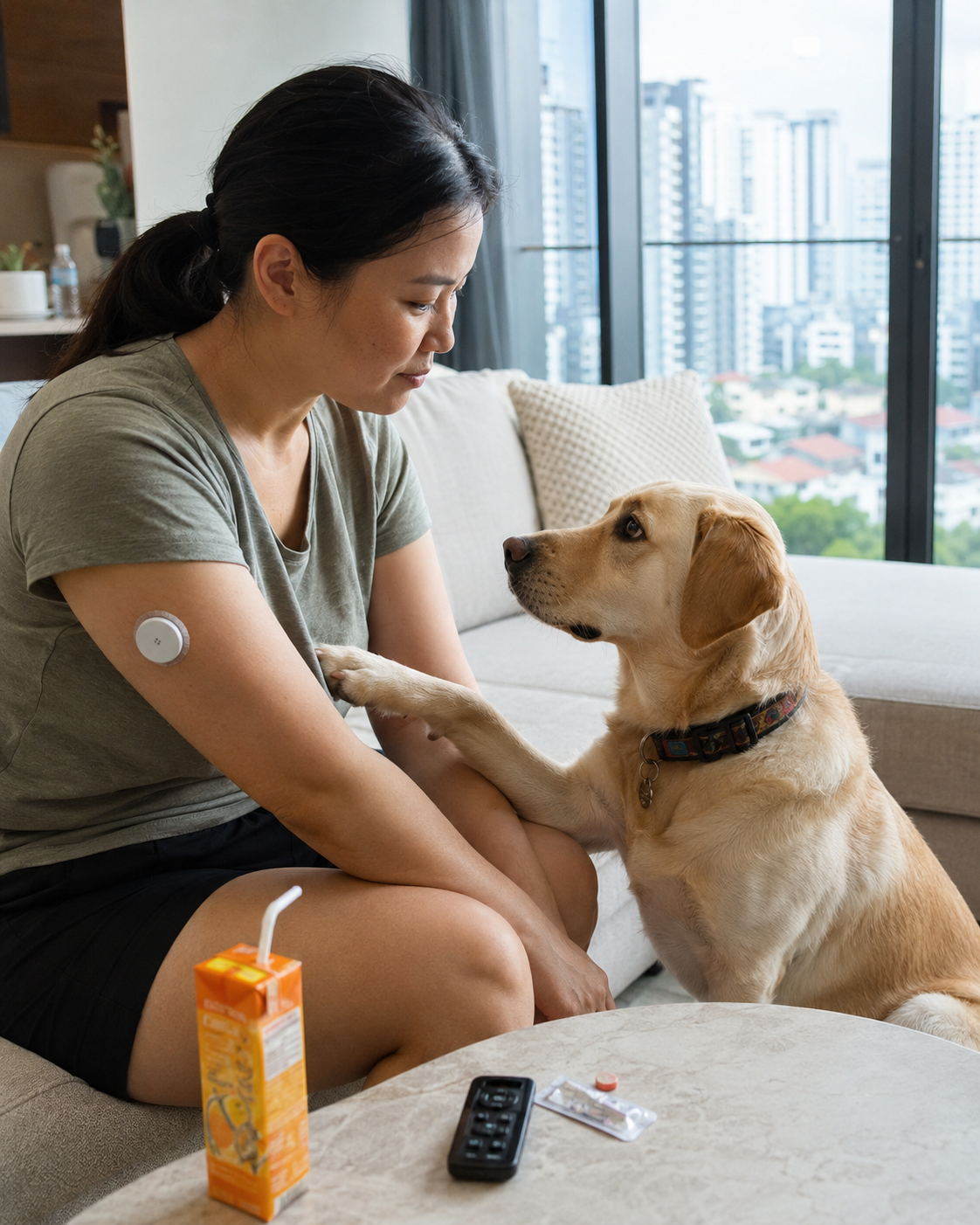
Chew lives with Type 1 diabetes. Her dog, Butter, has been trained to recognise changes associated with dangerously low blood sugar.
When Butter detects something is wrong, the licking is not simply asking for attention. It is an alert.
Butter has even been trained to retrieve a sweetened drink when Chew needs to raise her glucose level.
It sounds almost unbelievable.
But behind that wet nose is one of the most sophisticated scent-detection systems in nature.
And scientists are beginning to understand what dogs like Butter may actually be smelling.
When Blood Sugar Falls
For someone living with Type 1 diabetes, keeping blood glucose within a safe range is part of everyday life.
One of the dangers is hypoglycaemia, when blood glucose falls too low.
In Singapore, HealthHub defines hypoglycaemia as blood glucose below 4.0 mmol/L.
The warning signs can include weakness, blurred vision, confusion, unusual behaviour and slurred speech. In severe cases, a person may experience seizures or lose consciousness.
Technology has transformed the way this is managed.
Continuous glucose monitors, or CGMs, can take glucose readings every few minutes and some can sound an alarm when levels become too high or too low.
But before sensors became so advanced, people living with diabetes began reporting something unusual.
Their dogs were behaving differently when their blood sugar dropped.
Some would paw at them.
Some would nudge them.
Others would lick, stare or refuse to leave them alone.
Was the dog simply noticing that its human was behaving differently?
Or could it actually smell what was happening?
What Does Low Blood Sugar Smell Like?
To us, probably nothing.
To a dog, the human body is constantly broadcasting information.
Our breath, sweat and skin release microscopic chemical compounds. Changes taking place inside the body can change that chemical mixture.
Scientists call many of these substances volatile organic compounds, or VOCs.
Researchers at the University of Cambridge investigated whether human breath changes during hypoglycaemia.
In a small study involving people with Type 1 diabetes, they found that a naturally occurring chemical called isoprene increased significantly when blood glucose became very low. In some participants, it almost doubled.
Humans cannot smell this change.
Dogs may be a different story.
The discovery gave scientists a possible explanation for something diabetic-alert dog handlers had been reporting for years.
The dog may not be smelling "sugar".
It may be detecting a changing chemical signature produced by the human body.
And isoprene may only be part of that signature.
More recent research continues to investigate combinations of chemicals in exhaled breath that could act as biomarkers for hypoglycaemia rather than relying on one molecule alone.
In other words, to a trained dog, a person's scent may contain information that is completely invisible to us.
Training the Nose
A diabetic-alert dog does not automatically understand what low blood sugar means.
The behaviour has to be trained.
Dogs can be exposed to scent samples collected when a person's glucose is low and taught that recognising that particular scent earns a reward.
Over time, trainers can pair the scent with a specific alert behaviour.
That behaviour needs to be difficult for the person to ignore.
A dog might repeatedly nudge a leg, paw at its guardian, lick them or perform another trained action.
Some dogs can then be taught a second task such as retrieving glucose tablets, a drink or an emergency kit.
The result is more than a dog with an extraordinary nose.
It is a working partnership.
The dog has to recognise the signal, make a decision and then communicate that information to a human.
But Can a Dog Really Replace a Glucose Monitor?
No.
And this is where the story becomes particularly interesting.
Scientific studies of diabetic-alert dogs have produced mixed results.
Some experiments have shown that trained dogs can distinguish hypoglycaemic scent samples significantly better than chance.
In one controlled scent study, dogs achieved sensitivities ranging from 50 to 87.5 percent, with high specificity.
Other research has found much less reliable performance.
A real-world study involving 14 diabetic-alert dog teams found large differences between individual dogs. Only three performed above chance during waking hours, and continuous glucose monitors often provided more dependable information.
Another study found that CGMs frequently detected hypoglycaemia before the dogs did.
That distinction matters.
A diabetic-alert dog should not be thought of as a furry replacement for medical technology.
Blood glucose meters and continuous glucose monitoring remain important tools for managing diabetes.
The dog can potentially become something else.
Another layer of awareness.
A Sensor With a Heartbeat
A glucose monitor measures.
A dog observes.
That difference may be part of what makes these partnerships so powerful for some people.
A dog is beside you at breakfast.
Beside you on the sofa.
Walking with you.
Sleeping near you.
Watching patterns in your behaviour that a machine cannot understand in quite the same way.
And unlike a device, that dog also happens to be a companion.
That does not make the dog medically superior.
It makes the relationship different.
For some people living with a condition that requires constant awareness, that additional pair of eyes, ears and especially nostrils can bring another feeling entirely.
Reassurance.
Why This Matters in Singapore
Diabetes remains a major health issue here.
Singapore's latest National Population Health Survey reported diabetes prevalence of about 9.1 percent among residents aged 18 to 74 in 2023–2024. Most diabetes in the population is not Type 1 diabetes, but the figure shows just how familiar the condition has become within Singaporean families.
Diabetic-alert dogs themselves remain unusual in Singapore and across much of Asia.
That is what makes Butter's story particularly fascinating.
Here is a working dog whose workplace is not an airport, police vehicle or security checkpoint.
It is someone's everyday life.
The Future May Begin With a Nose
Perhaps the most exciting part of this story is that dogs may eventually teach us how to build better medical technology.
If researchers can determine exactly which combinations of chemicals dogs recognise when something changes inside the human body, that knowledge could contribute to new non-invasive sensors.
Imagine breathing into a small device and receiving an early warning that your blood sugar is becoming dangerously low.
Researchers are already studying breath-based chemical signatures with exactly that kind of future in mind.
The dog, in that sense, is not competing with technology.
It may be helping inspire it.
For thousands of years we have trained dogs to use their noses to find food, follow people, detect explosives, locate drugs and search for missing humans.
Now we are discovering that some of the most interesting things they may be capable of finding are not somewhere out in the world.
They are happening inside us.
And sometimes, the first warning might come with four paws and a cold nose.
Because danger does not always make a sound.
Sometimes, it has a scent.
Share this story
Discussion (0)
No comments yet. Be the first to share your thoughts!
Stay Connected
Get stories like this in your inbox
Join our community of design-minded pet lovers. Curated stories on culture, travel, and modern pet living — delivered to you.
Get Involved
Inspired? Share Your Story
Pet Culture Asia is shaped by its community. Pitch a story, upload a photo, or share a hidden gem.